Sunday, November 11, 2012

Savage Race - Little Everglades Ranch

Well, the boys at Savage Race have done it again. Each event has eclipsed the last and on October 20th at Little Everglades Ranch in Dade City, Florida, they proved to 4,000 adrenaline junkies that they're the official peddlers of pain in the mud race community. In a span of only six miles they built 25 brutal obstacles including the three-story "Colossus," a twisted half pipe which leads to a swallow-your-stomach water slide and the innovative "Evil Bars," which is the silverback gorilla to other races' playground jungle gyms.

Starting line stampede - Photo ©Savage Race/Mac Stone
Again this year, I was assigned to shoot the race and was stoked to know the participants would be slogging through a mini version of my favorite stomping grounds, the Everglades. As always, it was a tough shoot accounting for a large area, harsh light, and of course, high intensity mud-slinging. All throughout the day I was climbing atop obstacles, chest-deep in water, or waist deep in mud. By the end I felt like I had run the race several times over.

Walkers on the "Nutt Smasher" - Photo ©Savage Race/Mac Stone
My approach to shooting these events is to make sure I get right in the middle of the action, or sometimes right below it. I've found that if I'm not physically engaged with course, then my photos will feel detached too. This philosophy can be dangerous for equipment, but much like wildlife photography, the safest option usually produces "safe" images and the Savage Race crew wanted edgy. So I tried to give them edgy.

Diving over the fire pit - Photo ©Savage Race/Mac Stone
Here's a handful of some of my favorites from the day as well as a few shots just to show you some of the obstacles. If you're into mud races and a day of fun with your friends, then you need to go and register for one of their upcoming events. Savage Race is creating the new standard for obstacle racing.

Starting line - Photo ©Savage Race/Mac Stone
Hay Stacks - Photo ©Savage Race/Mac Stone

Championing the Hay Stacks - Photo ©Savage Race/Mac Stone

Captain America helping a friend up "Colossus" - Photo ©Savage Race/Mac Stone

Nutt Smasher - Photo ©Savage Race/Mac Stone

Not quite up the Colossus - Photo ©Savage Race/Mac Stone

Grinding the Evil Bars - Photo ©Savage Race/Mac Stone

Colossus half pipe - Photo ©Savage Race/Mac Stone

Tazed N Blazed - Photo ©Savage Race/Mac Stone

Gettin Tazed N Blazed - Photo ©Savage Race/Mac Stone

Priceless face before getting shocked - Photo ©Savage Race/Mac Stone

Fire jump - Photo ©Savage Race/Mac Stone

Evil Bars - Photo ©Savage Race/Mac Stone

Shriveled Richard - Photo ©Savage Race/Mac Stone

Colossus - Photo ©Savage Race/Mac Stone

Scaling the 96'' Stiffie - Photo ©Savage Race/Mac Stone

Nuff said - Photo ©Savage Race/Mac Stone

Greg Stone hangin on the Evil Bars - Photo ©Savage Race/Mac Stone
Davy Jones' Locker - Photo ©Savage Race/Mac Stone
Backflip off Davy Jones' Locker - Photo ©Savage Race/Mac Stone


Savage Race founder Sam Abbitt trying his Wicked Bars - Photo ©Savage Race/Mac Stone
Air Force team looking for their keys - Photo ©Savage Race/Mac Stone

And my favorite photo of the race: the Air Force team breaking into their own car to get their keys out.

Tuesday, November 6, 2012

Election Day

Presidential overthrow march - Lucio Gutierrez - Quito, Ecuador - 2005 - Photo © Mac Stone
Seven years ago in Ecuador I watched as Quito fell apart during a violent presidential overthrow. Molotov cocktails rained from the sky and buses burned in the street. It was a terribly sad time. Friends of mine were rushed to the hospital 
after getting hit by tear gas bombs and the citizens of Quito lost all faith that democracy was on their side. 


On election day, I always think back to this experience and how grateful I feel for America's order, conduct, and civility towards the sacred right of voting. For everyone caught up in the seemingly endless upheaval and turmoil of divisive politics, remember that we're all Americans and entitled to our own view of how our country should be run. Diversity on all levels is what makes this country great. Embrace the process and your friends or family who might share opposing views because no matter the outcome we'll wake up tomorrow and still need to share the streets, restaurants, and this beautiful country together. 


Margie Boyd - A Bar A Ranch - Wyoming - Photo © Mac Stone


Thursday, November 1, 2012

Scary Things...

Cottonmouth - Big Cypress National Preserve - Photo © Mac Stone
We all have things, or maybe ideas rather, that crawl under our skin and cause our heart to beat a little faster. I have a few friends who are absolutely terrified of snakes. In fact, just looking at this photo above makes them extremely uncomfortable. One friend told me "Mac, I mean this in the nicest way, but I hate this (photo)." I've never had this sort of visceral fear of anything tangible, that I can think of. I love snakes, insects, alligators, and all that creepy crawly and squishy stuff. I'm more afraid of situations or of the idea that I'm not in control. Maybe some of you have this too, but I've always been afraid when standing atop tall buildings or bridges that my alter ego is going to rise up and make me jump. This is the same dark side that starts to itch when police walk by and a part of me feels the urge to grab their gun and say, "ha ha, just kidding." Does this happen to anyone else? Weird.

Well, if you're one of the people terrified of images of snakes and alligators and other denizens of the swamp, then this next part isn't for you. For the next two months I'll have 12 large format canvas prints on exhibit at Corkscrew Swamp Sanctuary in Naples, Florida. Running from November 5th until the end of December I'll be displaying and selling these prints which highlight the Everglades watershed and its many landscapes and fauna. Go check it out if you have the chance, because I will be unveiling a few images which I've never displayed to the public. If you're wanting to jump on the Christmas shopping early, head to the swamp because the canvas prints at 2 ft x 3ft are on sale with part of the proceeds going to Audubon's beautiful Corkscrew Swamp Sanctuary. What does a 2ft x 3ft gallery wrapped canvas look like? Well, I'm glad you asked...


Thursday, October 25, 2012

Get Low

"Edge of the World" - Florida Bay - Everglades National Park
It's easy to get stuck in a rut with photography. After your 500,000th image, it might feel like you've done it all before. Luckily though, it's often just as easy to break out and explore new possibilities by simply changing your perspective. I get inspiration from other photographers all the time. In fact, it's part of my daily routine to research other artists and see what they're doing. One photographer in particular, John Spohrer, based out of Apalachicola, Florida would create these arrestingly dramatic images by shooting a low angle on water. Simple, right?  This isn't necessarily an Einstein moment but this technique is often overlooked by photographers. When applied in the right situations, it can completely alter the depth and feel of your images.


Take this scene for example. To me, this is a standard one-dimensional view of a summer squall in Florida Bay. You have some water, you have some storm clouds, all of which seem to appear on the same visual plane. While this image might be good for an advertisement or calendar, to me, I'm not moved to feel anything when I look at it. 


Holding my camera just above the water's edge over the boat with a wide angle lens (Canon 16-35mm) and employing fast shutter speeds by means of high ISO I made a series of images without looking through the viewfinder. Only an inch above the water, this proved a little dangerous as a rogue wave lapped the base of my camera. Not good. Still, I was able to make a few frames from this new perspective. What resulted was this very multi-dimensional image which gives a turbulent and almost apocalyptic aura. The way the water eliminates the horizon creates a sense of impending doom, like Columbus must have imagined when sailing towards the edge of the Earth. All I had to do was hold my camera close to the water. 

Here are a few more dualities so you can see the benefit of simply changing your perspective. To me, the lower angles just have a way of filling the space more efficiently. Take note how your eyes want to linger a little more. Who knows though, maybe you'll like the standard images better. I'm curious to hear what you think. 


With the low angle, you get much more action and interesting patterns in the water from reflected light. This way, the water doesn't just become empty space, but instead helps define and draw your eye into the subject.  


Wednesday, October 10, 2012

NANPA High School Scholarship Program

A year ago I wrote about the NANPA High School Scholarship Program which was held in McAllen, Texas where ten students were chosen from all around the country to attend one of the most prestigious photography summits in the US. If you missed it, you can read about it here.


In February of next year, 10 more lucky students will have the chance to attend NANPA's fourteenth high school scholarship program for a chance to learn from the industry's top shooters and photography publishers. I'm extremely excited to announce that I will be taking over as chair of this program and will be joined by instructors Ray Pfortner, David Moynahan, and Marina Scarr in Jacksonville, Florida. Only ten years ago, I was one of the fortunate few selected for this program in Albuquerque  New Mexico and I can't begin to count the ways it has shaped my life. Now, here I am about to take lead on cultivating the next generation of nature photographers in my home state!

We are seeking talent from all over, so if you know of any high schoolers or students 14-18 years old with a passion for photography please send them this invitation. You never know how it might shape their lives.


Monday, October 8, 2012

Pretty in Pink

The spoonbill saga continues. I just went down to the Keys for a week to train the new head of spoonbill research at the Tavernier Science Center. When I walked in the office, Dr. Jerry Lorenz handed me a book from Bearport Publishing. I completely forgot I submitted images nearly 6 months ago on this project and here it was, printed, bound, and ready for distribution.


The author, Stephen Person, contacted me early this year to help collaborate on a children's book about the roseate spoonbill and the work we did with National Audubon and the Tavernier Science Center. Jerry helped with the text and while it has the illustrative feel and design of a children's book, it's actually incredibly informative about the Everglades ecosystem and the lives of these beautiful birds. If you have a child who needs a good book this Christmas, give this one a shot. You can tell them you know one of the photographers!

You can find it here on Amazon: Roseate Spoonbill, Pretty in Pink

Thursday, September 13, 2012

Caption Contest on Facebook


"Bird statue. Bird statue. Nothing happening here; just move along" - Lynnie Raybuck (Wednesday Sept 13th winner)

Sorry for my absence on the blog but I've been giving more attention lately to my other neglected child: Facebook. If you haven't logged on to find the fan page where I post almost daily images then you're missing out. Here's the link: Facebook Fan Page

This week I've been posting various bird images and opening up the comment section to visitors to submit their most clever captions in hopes of winning a 2013 National Audubon calendar. I have plenty to give away, so feel free to share the contest with friends. Here are Tuesday's winners:


"The guys at Paul Mitchel called it edgy... is it me?" - Janie Yancey

"Hide ya kids, hide ya wife!" - Winston Nagan (referencing this)

Wednesday, July 4, 2012

Love for the Swamp

Mac Stone BBC Swamp

For those of you that missed it in the bookstores, BBC Wildlife Magazine did a 13-page feature portfolio on my work in America's Swamps. This was pretty exciting for me as a photographer, but especially significant from a wetland conservationist standpoint. We're finally getting swamps some positive PR!
The BBC staff are top notch. They're extremely thorough, inquisitive, and insightful; so when I was going back and forth with them about the layout and captions, it was a surprisingly painless process. The only complaint that they expressed was not having enough pages for the images I submitted. Can't get better feedback than that!

If you'd like to check out the actual portfolio complete with captions in PDF version: Click Here 

Or, you can find the online gallery of some of these photos here: America's Swamps

Monday, June 18, 2012

Congaree National Park

Water moccasin basking along Cedar Creek in Congaree National Park - © Mac Stone
Three years ago during the spring season I worked as a canoe guide and naturalist in Audubon's Francis Beidler Forest. You've heard me brag about this place countless times but that's because it's one of the more magnificent places I've ever been. I remember feeling like I was part of a team, not just because I worked with other dedicated people in the same building, but because we were constantly trying to find new recruits for Four Holes Swamp. We had to earn the adoration of each wary soul that walked through our door because we wanted to be the darling of the lowcountry, the gem of the sodden bottomlands. This might have been an easy feat if we were the only ones promoting large tracts of cypress and tupelo swamp, but there was another nature reserve only an hour away with a bigger budget and a wider audience also offering boardwalk tours, canoeing, and large old-growth trees: Congaree National Park. In my three months of living only 45 minutes away, I never took the time to visit the park; partly out of spite, partly out of a swelling pride, but mostly because Beidler had everything I needed. I didn't realize it at the time, but I had been chugging the Beidler Kool-Aid for so long that when I left for the Everglades in the fall of 2009 and ran into a former Congaree National Park seasonal, we got into a heated debate as to who's swamp was better. We had both been trained in the arts of tour-guiding and we knew our tag lines well. I would say, "We have the largest stand of old growth tupelo and cypress swamp in the world, enough said." Heather would then retort with "Well, we have the largest tract of old-growth bottomland hardwood forest in the world." And there we stood, proud, stubborn, and divided.

Old-growth cypress and tupelo trees along Cedar Creek in Congaree National Park - © Mac Stone
Such quibbling over semantics may seem petty stuff, but even years removed from our dutiful posts we were still elbowing for the top spot as South Carolina's premier swamp. A week ago, I finally decided to put their words to the test and see what Congaree was all about before the summer heat rolled in. I readied my kayak, loaded my equipment in dry bags, and drove two hours South to the National Park. I wrote my former Beidler colleagues confessing my treasons and begging their forgiveness. This rivalry runs deep. I was immediately impressed having just spent the last two and a half years working in Everglades National Park and paying the $16 to camp at Flamingo plus a $5 entry fee to find that Congaree was completely FREE! 26,500 acres at my complete disposal, without so much as a dollar spent. 

Brown watersnake - © Mac Stone
I put in at Cedar Creek and planned to paddle until finding a comfortable place to set up camp. I was immediately blown away by the amount of snakes sunning on the branches and fallen logs that stretched across the shallow blackwater creek. 

Colorful cottonmouth at the base of the tupelo tree - © Mac Stone

It was herpetologist heaven. By the day's end, I counted 43 snakes: 33 brown water snakes, 8 moccasins, and 2 red-bellied watersnakes! One of the first ones I saw was a small cottonmouth brilliantly colored (pictured above) from having just shed its skin. My timing wasn't great, though, and at 3:00 PM in the swamp, the light can get pretty harsh. I waited around for a passing cloud and had my tripod ready. Thankfully it was patient enough for me to get close with a wide angle lens and attempt a 3-second exposure. I used a polarizer to take off the glare from its scales and a warm reflector to add fill light to the tree. Will all my movements the snake finally fled, which made for a nice blur effect (see thumbnail to the left). 

Wise Lake, Congaree National Park - © Mac Stone
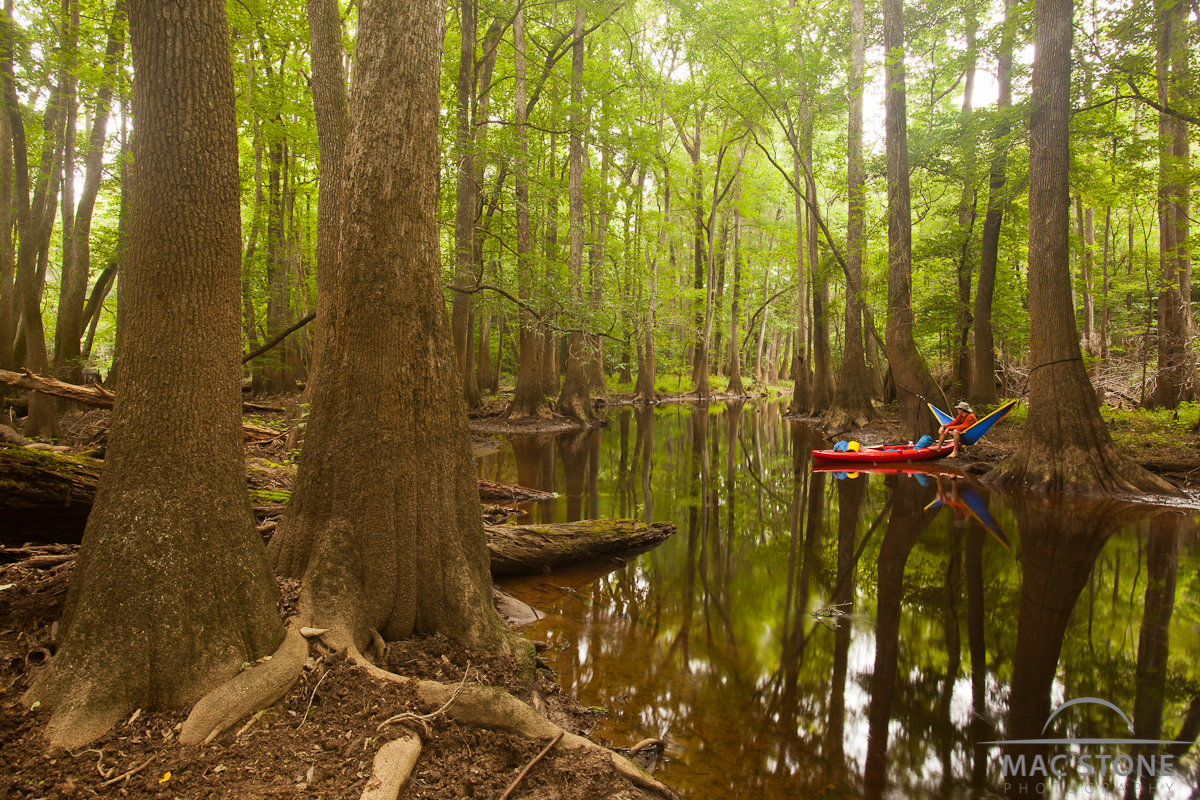
Along the trail I found several nice compositions of spindled tupelos and arching branches near Wise Lake. Prothonotary warblers darted in and out of hollowed trees and cypress knees and below the canopy darkness came quickly as the sun set. With low water levels, feral pigs had rooted the grassy banks to a muddy pulp so I decided to find a nice place for my hammock instead of dirtying up my tent. Just around the bend proved a perfect spot. 

Primitive hammock camping along Cedar Creek - © Mac Stone
Soon, all manners of shrieks, chirps, and buzzes filled the spaces between the trees and leaves, bouncing off the water and surrounding my hammock. For a moment, laying still and looking up to the canopy I thought a pair of barred owls had perched right next to my head they were so loud. Lightning bugs beaconed green flares - staccato flashes through the limbs as if a meteor shower rained overhead. I was overwhelmed with a peaceful oneness in this ancient swamp and a surprising comfort settled over me. I'm sure Hernando de Soto felt the same when he first arrived to Congaree in 1540. Even with the lullabies of frogs and crickets, I was restless in my hammock, my creative side burning to find out what the scene looked like from the other bank. Grabbing my flashlight, I mounted the camera on the tripod I had set earlier for the composition above and started a series of long exposures painting the trees and creek banks of my airborne campsite. 

Self-portrait hammock camping - © Mac Stone
Exhausted, I finally fell asleep by 1:00 AM, a deep, calm sleep. I don't know if I would or could compare this place to Beidler Forest. They are two different ecosystems and too unique to pit against one another. Regardless, I think competition is healthy. South Carolina is all the luckier to have two of the world's most impressive tracts of lowcountry relics within an hour of each other. I say let them duke it out, I'll gladly allow them to vie for my affection.