Showing posts with label Florida. Show all posts

Thursday, September 4, 2014

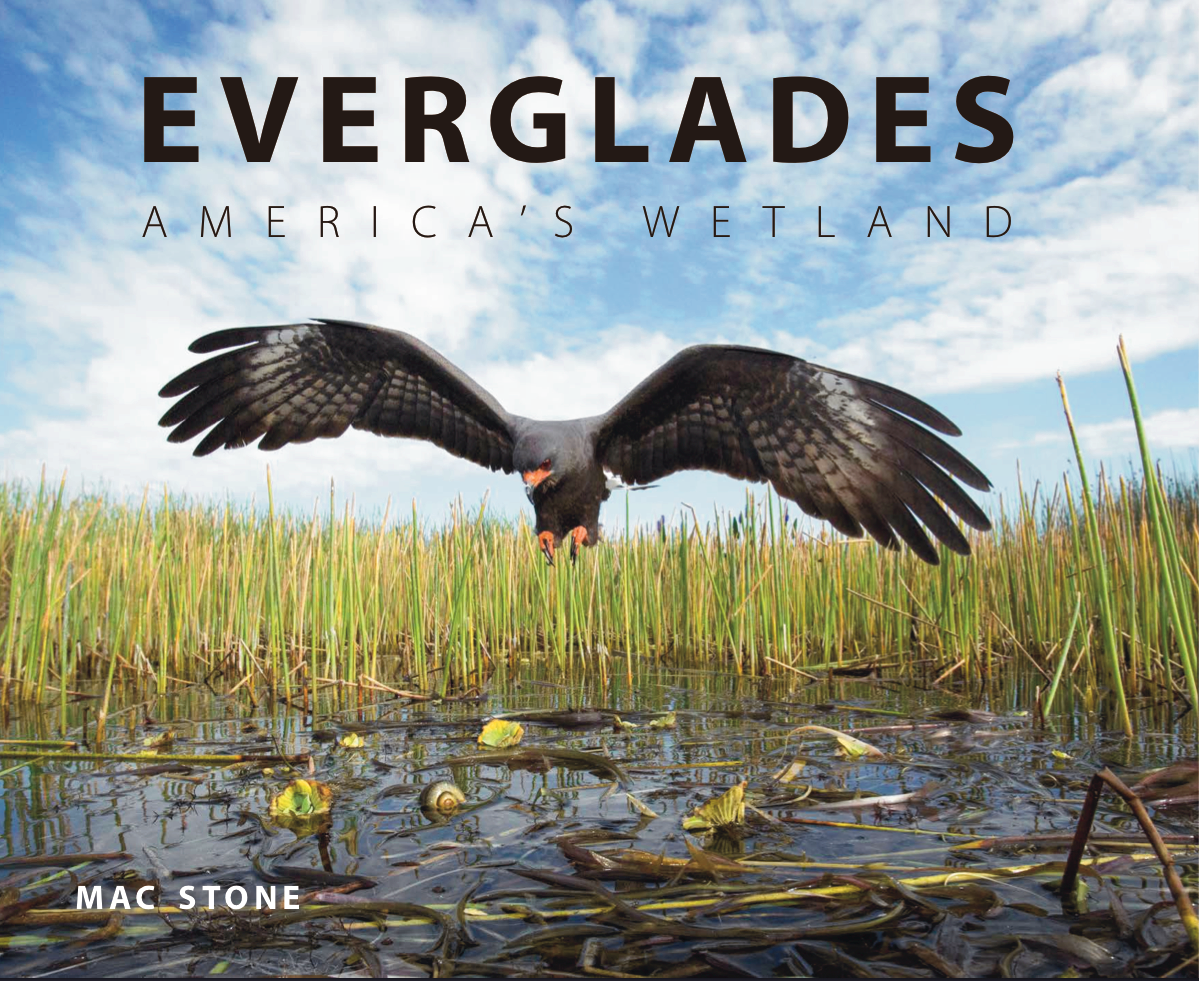
Everglades: America's Wetland Pre-Order

Everglades America's Wetland photography book by Mac Stone


The time has finally come. Five years in the making, I'm proud to start the unveiling of my book, Everglades: America's Wetland. Published by University Press of Florida, this large format coffee table book contains 304 pages with over 240 images. I've had a hard time keeping these photographs under the covers, but I'm glad I waited. Along with some of my best unpublished (until now) work, the book has 15 essays from some of the top minds in Everglades conservation.

Before the book reaches it publishing date, I wanted to offer a pre-order opportunity for those of you who want signed copies and a discounted rate. I'll also be discounting a series of fine art prints to accompany the book. The book's website is www.EVERGLADESBOOK.com

Thursday, May 1, 2014

Crystal River - Three Sisters Spring

Two manatees show affection in Crystal River
"Thicker Than Water" - Manatees in Three Sisters Spring
Growing up in Gainesville, swimming with manatees in Crystal River was somewhat of a rite of passage. I remember my first time so clearly, waking up before dawn and heading out into the cold morning, boating along a smoking river. I remember the initial struggle of convincing myself to jump in the water while my breath still materialized in a crisp cloud. And I remember seeing the giant mammals three times my size yet graceful, pensive and at home in Three Sisters Spring.

Carlton Ward boats out before dawn on Crystal River. In the background a tour boat full of eager passengers. 
When I started getting into underwater photography, I knew I'd eventually return to immortalize that same wonderment I felt nearly fifteen years before. This winter, when I got a call from Carlton Ward Jr to spend a few days looking for aquatic cows, I packed up my truck and headed out.

Gray snappers school near the main vent in Three Sisters Spring
A Florida snapping turtle walks across the sandy bottom in search of its mate.
Carlton walks to the put-in.
The forecast called for rain and thunderstorms on the second day and we were a little discouraged because we came to an empty spring on the first. By this time in the season, the daily temperatures were rising and we weren't too hopeful that we'd find manatees. That morning, a massive storm cell was pounding at the roof and with a only a few hours of sleep under our belts, the snooze button cried for mercy when the alarm went off. It was a combination of the fear of total failure and faith that something good might happen that ended up dragging me out of the house. So, at 5:30am albeit reluctantly, we geared up and took off to the water. 


We swam, hauling our gear and a dive flag for what seemed like a mile. Going into the spring run, it was dark but crystal clear. Floating at the surface, all I could hear was a barrage of rain pounding hollow notes on my wetsuit while thunder bellowed overhead. When I submerged, there was silence. Ten yards ahead a group of manatees slept next to the spring boil. It was absolutely magic. 


The rain created an incredible atmosphere. Looking up, the intoxicating arctic blue of Florida's springs was accompanied by liquid diamonds dappling the surface. I couldn't believe my luck.


We enjoyed the intimate session with the manatees for almost an hour before a group of eager snorkelers showed up. I hate to admit it, but I loathed that they intruded on our private session. I had heard plenty of stories about tourists scaring the manatees and murking up the water. 


It was a rainy day, though, and the groups were small, maybe 60 people total came through. The longer I spent in the water I started to notice that the tour operators corralling the visitors were deliberate and extremely attentive to how the manatees were approached. Each visitor was required to watch an instructional video on how to swim with manatees beforehand and it showed. The visitors floated at the top of the water column, not disturbing the sandy bottom, and they enjoyed their safe distance, probably never to forget their experience of swimming with the gentle giants. Then, they left, and the manatees stayed, sleeping in their cool blue sanctuary. 

Mullet school along the mangroves in Three Sisters Spring.
There's something to be said about proper wildlife management and responsible business owners working in tandem for a mutual goal. In my years of being outside and working my way around tour groups, I've never been so impressed with how well they balanced their excitement with their stewardship. Education is the key, and I'm stoked to see it worked. USFWS invested in making the videos and speaking with their local tour operators and it has paid off. Go team.

Mac Stone and Carlton Ward pose for a photo in Crystal River. 

Saturday, January 19, 2013

Sandhill Cranes - Mycotoxins


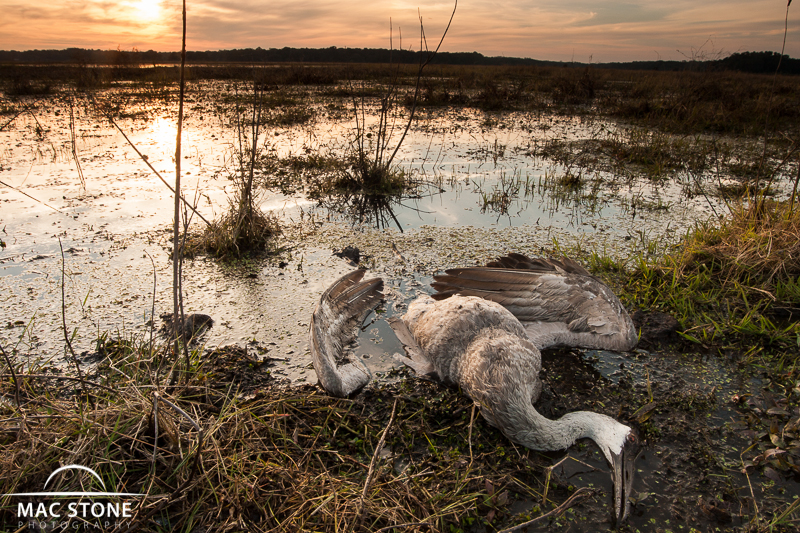
In an ecosystem rife with bobcats, coyotes, alligators, vultures and snakes, it's rare to see a dead animal without any apparent wounds. So when I stumbled on this scene in Kanapaha Prairie I asked myself, what could have done this? I recently posed this same question to a group of fans on my Facebook page and surprisingly, two of them had the right answer. 

Sandhill cranes fly over Kanapaha Prairie - Gainesville, FL -  Photo ©Mac Stone

The sandhill cranes' arrival in Florida is the sure sign of winter. They come in with the staccato trumpet calls that pierce the morning air and echo through the prairie's live oak rim. Their migratory populations have ebbed and flowed over the years on the prairie, some years with over 1,500 individuals and other years only a few dozen. There doesn't seem to be a solid explanation for this, but some believe its due to the amount of dog fennel that grows up to 6 feet high and gives the cranes a natural barrier from potential predators like coyotes and bobcats. Without the vegetation, they simply pass over the prairie and onto greener pastures. 

Sandhill cranes at sunrise on Kanapaha Prairie - Photo ©Mac Stone

One of my favorite things in the winter is to go out and photograph the sandhills at sunrise. When polar fog exhales from the wetlands, their silhouettes dot the horizon and make for some great images. On these mornings though, I'm not the only one stalking birds. If sandhills usher in the day with their calls, then coyotes are the denizens of the night. Their mad cackling can be heard from a mile away and I can't help but wonder while I'm sitting around the backyard fire, what they're howling about. No matter how close they sound, every time I go looking for them they're nowhere to be found. After their raucous nights, though, I'm always certain to find the remains of their prey in a cloud of feathers on the cold prairie floor. 

A lone coyote stalks a flock of sandhill cranes on Kanahapa Prairie - Photo ©Mac Stone

So it was curious to me, the morning I stumbled upon the dead sandhill, left untouched. Then I started replaying the previous day's events and images, and I knew the answer immediately. Out of the flock of cranes I had been photographing the day before, when all others flew away as I approached, there was one crane who stuck around. At first it looked like it had an injured wing as it fumbled about,  hopelessly attempting to fly. 

Sandhill crane infected by mycotoxin, fusariotoxin - Kanahapa Prairie - Photo ©Mac Stone

Not wanting to stress the bird or cause it any more pain if its wing really was injured, I stayed back and watched it for a while. It was really sad to watch. The crane would call out to its flock in a broken shrill and the others didn't respond. It's limp neck eventually lost all mobility and hung low as if paralyzed. In the deeper water, it could barely keep its beak high enough to breathe. I apologize for the graphic photos.

Sandhill crane infected by mycotoxin, fusariotoxin - Kanahapa Prairie - Photo ©Mac Stone
Finally, I wrote it off as a strange injury and went home knowing it would soon turn into food for the prairie. The next morning when I saw the sandhill laying dead in the water where I saw it yesterday, I wondered how long through the night it suffered, as this was almost certainly the same bird. The images of its broken body were hauntingly fresh in my mind, so I did some research to see if anyone else had documented this behavior. What I found was alarming. 

According to the National Wildlife Heath Center, this paralysis and eventual death is caused by a toxin produced by a fungus found in corn and peanuts, called mycotoxin, or more specifically, fusariotoxin. Fusariotoxin will cause a flaccid paralyses of the neck and wing muscles as well as neurological damange. Wild migratory waterfowl like cranes poisoned by this fungus have thus far only been documented in Texas and New Mexico from contaminated grain fields. Cranes can ingest the fungus while foraging during low temperatures when other food sources are unavailable. Who's to say where the bad corn or peanuts were eaten; it could have been in Georgia a few weeks prior. According to biologists, there are about 300 cases in Florida each year, but this series of photos is the only ones I could find in Florida, although I've seen this condition twice on Kanapaha Prairie alone (if there are other accounts of this in Florida, please let me know in the comment section below). 

Thanks for reading. If you'd like to read up a little more on this strange condition, click here, or here. Also, as a side note, I did not do an autopsy on the bird, so for scientific purposes I have to say that based on my field observations alone, I put mycotoxins as the probable cause of death. 

Sandhill crane, probable cause of death: mycotoxins from molded grains - Kanahapa Prairie - Photo ©Mac Stone

Tuesday, August 9, 2011

Trolllin' and Pollin' Everglades Style

The same places I've been visiting since I arrived here are still continuing to surprise me. There's no shortage of adventure and discovery in Everglades National Park, that's for sure. With my friend, coworker, and backcountry fishing guide Pete Frezza, we headed out before dawn to meet the sun as it rose over the Everglades. Launching his boat we battled swarms of mosquitoes fully understanding our blood was a necessary sacrifice for our plans that day.


Right off the bat, the calm water began rippling out from the banks as juvenile tarpon rolled violently on unsuspecting minnows. I had never seen anything like that in South Florida. The only time I watched fish rise this frequently was on the North Platte River in Wyoming, and those were 15'' trout. These were 30'' tarpon. By my third cast I had one on the fly and it sent itself rocketing into the blue morning sky. What a way to start the day!


Pete was nice enough to let me have the first casts, but promptly after I wanted to see how it was done by a pro. Watching a seasoned fisherman cast into the tight spots around mangroves is like watching an artist at work. His fly danced and line undulated in beautiful loops and fell silently on the water, presenting an unresistable morsel to the fish below.


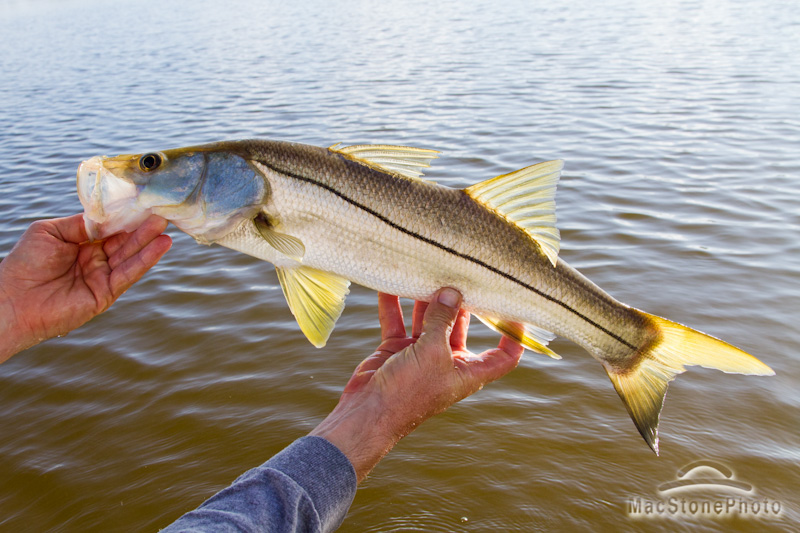
And just when we thought it couldn't get any better than fishing on a Monday, a double rainbow appeared over the water. We stayed in this spot for the next two hours and found a few young snook which was encouraging to see since their numbers declined so abruptly after the 2010 freeze.


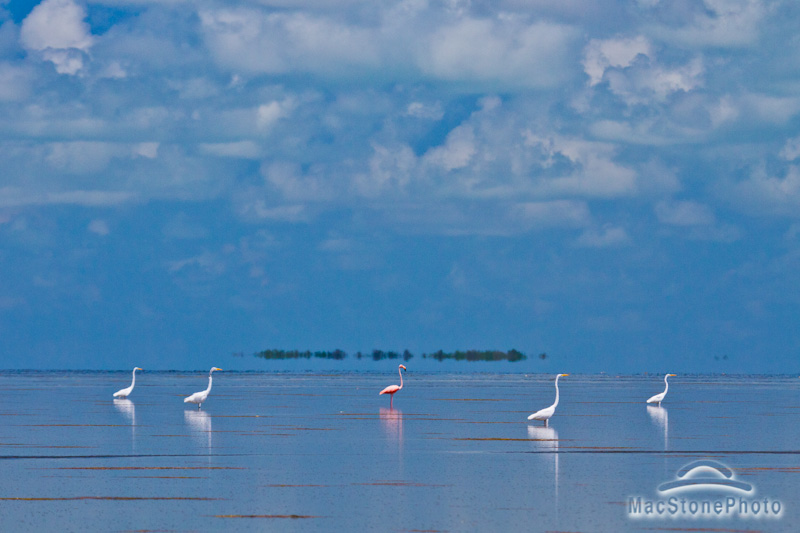
Despite the adrenaline-filled morning and intense satisfaction I felt, our day was far from over. A few days earlier we received word from Garl's Coastal Kayaking that they spotted a flamingo around one of the flats on Florida Bay. Historically, this wasn't an uncommon sight, as the main marina is called Flamingo from the vast numbers of pink birds that spent their summers here. Unfortunately, as a result of the plume trade, hurricanes, and continued hunting in Cuba, it's extremely rare to see these iconic birds in South Florida. While our expectations were low, our hopes soared, carrying us on a 10 mile boat ride without the use of a motor through pole and troll-only zones.


The bay was like glass and we could see redfish tailing in the flats as the tide drew out. Along the banks, dense mats of turtle grass floated on the surface, uprooted by storm surges and water currents, then elegantly arranged in lava-like tendrils of varying colors. Great white herons dotted the horizon waiting for unsuspecting toadfish and crabs to swim by. Just when it couldn't get any better, all of a sudden by the shoreline we spotted it; my very first wild flamingo. 


I've seen plenty of flamingos in zoos and postcards in all the stores down here, I've even drunk out of a plastic one, but never fully appreciated these birds until this moment. I couldn't believe how they dwarfed all the shorebirds and wading birds along the coast. Maybe because they're rare, maybe because we pulled 5 miles to get there, whatever the case I was overcome with this entitled feeling that I had been let into some special club. My camera was working, batteries at full charge, and an empty memory card, things were looking good. We approached slowly, but we couldn't quite get close enough for a candid image. Wary of people, the flamingo would promptly take off as soon as we got within 50 feet, extending its long awkward neck and using the flats as its runway. It seemed to take forever for the bird to get into the air.


After another hour, we saw the flamingo land near some other wading birds. Hoping that power in numbers would make this bird feel safer we headed towards them and were able to get a little closer. Just then, my polarizer fell off my lens and scared the bird away. I managed to get some frames off just before, but still, with such a rare sighting, the images I was making didn't match what I was feeling. Fortunately, the flamingo landed with a group of white herons. Seeing the image line up, Pete helped paddle us into a position to juxtapose the mangrove islands of Florida bay and this odd family of birds against the afternoon horizon.


Given the light and the physical circumstances, I couldn't have been happier. And just in time too, because looking behind us, a storm was brewing, forcing us off the flats to bring our 15 mile pole and paddle to an end. I'm still buzzing from the energy.


Monday, July 11, 2011

Mangroves


I've been obsessing over mangroves lately. They are the unyielding force of the Everglades. Each of them with a unique footprint and a character all their own. Constantly bending and stretching to reach fertile ground, they posses a certain ingenuity, an intelligence, even.


Mangroves are tricky subjects to photograph, though. Their waxy leaves reflect harsh light in the afternoons and around sunset, even the slightest wind will move their outstretched branches during long exposures.


I've found that the best time to see them is in the mornings because the wind is much calmer. For the most distinct subjects, however, I have to boat out into Florida Bay an hour before sunrise to catch the first light. Luckily, they're right on my way to work.   


One of the more bizarre landscapes I've seen was right at the end of the dry season at the top of Florida Bay. For a week, North winds pushed water into the mangrove swamps along Taylor River. The ground, still parched from the months without water, stayed defiantly cracked and broken regardless of the water that now filled the area. I'd been to this place dozens of times and never seen it this way.


My next goal is to get underwater and see what they look like from below. Stay tuned...

Wednesday, June 29, 2011

"Swept Away"

Swept Away - Florida Bay
Two weeks ago I made a new image in Florida Bay that will become part of my print portfolio. I was having trouble coming up with a title that resonated with me personally and spoke to the transient nature of this wonderful place so I called on some help. After posting the image to Facebook, I asked all my friends for their ideas to give this photo the last creative "umph" that it needed. In exchange for their brilliant nuggets, I offered an 8 x 12 matted and signed print to the winner. I didn't expect too many people to respond, but after three days, there were 100 comments with all kinds of inspiring input. I was so overwhelmed by everyone's enthusiasm. I had a tough time deciding which one would define this new image, but I kept coming back to one in particular. Caitlin Sandersen Friedman, and old friend from high school came up with the winning title "Swept Away." I love it when art becomes collaborative!  

The new print will now be available at my running gallery in The Great Frame Up in Gainesville, Florida or online through my website MacStonePhoto.com. If you'd like to get in on the next title contest, find me on Facebook!

Sunday, May 1, 2011

Venture Out! Everglades Invader

A nine-foot Burmese python hides amongst the leaves in an upland hammock

Many of you have heard the stories about pythons taking over the Everglades. While I wish this were another Skunk Ape story hyperbolized by one sighting, for those of us who live and work in the park this is a very real and scary problem. Burmese pythons (Python molurus bivittatus) are one of the world's largest snakes and unfortunately have been released into the park. Due to their incredibly high survival rates and south Florida's favorable climate, their populations have exploded over the last few years. It is estimated that anywhere from 5,000 to 200,000 pythons are currently residing in the Everglades. Research biologists in the park are working hard to find new ways of controlling their numbers.

Trey Kieckhefer, wildlife biologist with the University of Florida

Last week I had the chance to accompany wildlife biologist Trey Kieckhefer to get a better understanding of the problem we're facing in the Everglades. One of his studies involves implanting a tracking device under the skin of nine pythons and rereleasing them into the park. While this many seem counterproductive to limiting the number of these invasive reptiles, the "Judas Snakes" as they're called, help lead biologists to other pythons during the breeding season and offer clues as to their behavior in south Florida. Normally when biologists encounter pythons in the field, they take them back to the lab for further research or euthanasia.

Biologists use radio telemetry to track the movements and habits of select pythons

Trey currently holds the record for finding the largest python in the park, at a staggering 16.9 feet. You would think a snake this big would easily be detected by the millions of tourists and workers that pour through the park entrance each year. However, as you will find in my next episode of Venture Out!, regardless of size, the Burmese python is difficult to locate even with radio telemetry and GPS tracking.

Enjoy the video and pray for our Everglades!